TaskRio vs Tasks.Bot for Multi Step Workflow Automation Software
Your team already runs on WhatsApp, but task handoffs keep falling through the cracks. Multi-step workflows expose every gap: approvals stall, deadlines slip, and nobody knows who owns step three. Choosing the wrong automation tool makes that worse, not better.
This comparison walks through how Tasks.Bot and TaskRio each handle complicated processes, where their automation depth diverges, and how features like voice notes, approvals, and GPS tracking stack up. By the end, you will know which platform fits your team and whether Tasks.Bot is worth a trial.
What Is Tasks.Bot? WhatsApp-Native Task Management Explained
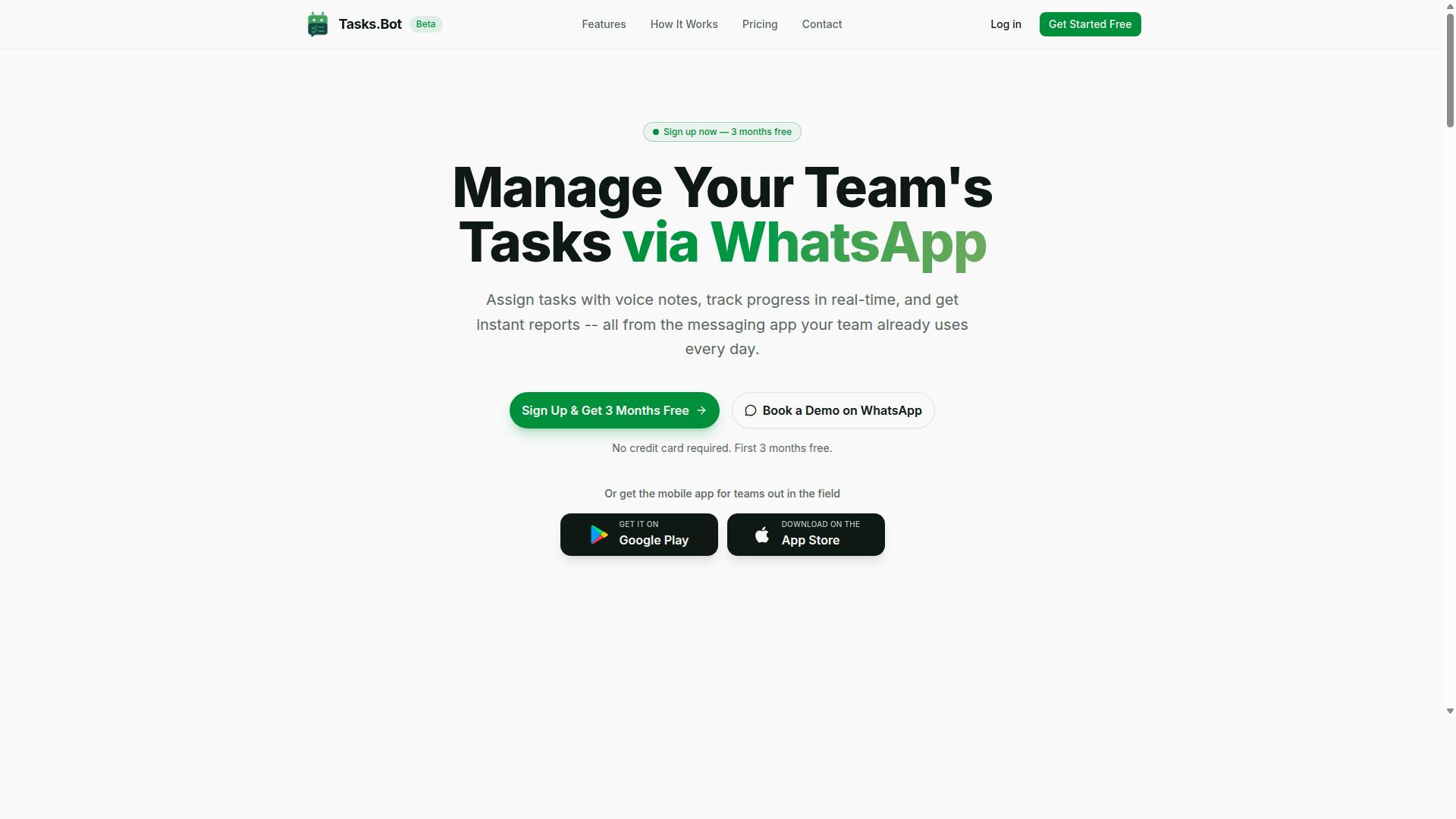
Tasks.Bot is a task management platform that operates entirely within WhatsApp, enabling teams to assign tasks, track progress, and receive reports without leaving the messaging app. That single design decision shapes everything about how the product works and who it suits.
Most task management tools ask a team to adopt a new habit. Tasks.Bot flips that expectation by living inside an app people already open dozens of times a day.
For teams comparing multi-step workflow automation software, understanding this WhatsApp-first approach matters. It explains why Tasks.Bot feels different from platforms built around a web dashboard or a visual workflow designer.
No new accounts, no new installs. Because Tasks.Bot runs natively inside WhatsApp, team members do not need to download separate software or create fresh logins. They work from the messaging app they already use, which removes one of the biggest barriers to adoption in task management.
That matters for multi-step workflow automation. A workflow only delivers value when every person in the chain actually uses it. When the tool meets people where they already are, participation stops being a battle and becomes a natural part of daily communication.
Tasks.Bot uses AI to interpret natural language and voice notes when creating tasks. Instead of filling out structured forms with fields and dropdowns, a user can describe what needs to happen in plain words, and the platform turns that into an actionable task.
This lowers the skill floor considerably. Field workers, sales staff, and managers who are not comfortable with complex software can still create and assign work in seconds.
It also fits how people already talk to each other on WhatsApp. Rather than translating a verbal instruction into a formal task record, the instruction itself becomes the record.
Alongside the WhatsApp experience, Tasks.Bot offers a mobile app built for field teams. The app includes features such as face-verified attendance and live GPS tracking, which address the accountability questions that come with managing staff who are not at a desk.
This combination covers two distinct needs. Messaging handles coordination and task assignment, while the app handles verification and location visibility. Together they support workflows that move between the office and the field.
Tasks.Bot is designed for teams already using WhatsApp as their primary communication channel. If that describes your organization, the platform slots into existing habits rather than demanding new ones.
It is also worth noting that the service is currently in beta and offers a free trial period. Teams evaluating it against platforms like TaskRio can test the WhatsApp-native model directly before committing.
In short, Tasks.Bot is a task management and multi-step workflow automation platform delivered through the messaging app your team already trusts. It reduces friction at the point of adoption, uses AI to make task creation conversational, and extends into the field through a dedicated mobile app with attendance and location features.
For teams whose work happens over WhatsApp, that is a genuinely practical starting point.
TaskRio vs Tasks.Bot: Which Handles Multi-Step Workflows Better?
When comparing TaskRio and Tasks.Bot for multi-step workflow automation, the key difference lies in their fundamental approach: TaskRio typically requires a separate app, while Tasks.Bot operates within WhatsApp.
Both platforms aim to streamline how teams move work from request to completion. The contrast is architectural. TaskRio is a standalone workflow automation tool, while Tasks.Bot is WhatsApp-native, meaning the workflow lives inside a messaging app your team already uses daily.
That distinction shapes everything downstream: how fast people adopt the tool, how tasks get created, and how much setup a workflow builder demands before the first automation runs.
This comparison covers where each platform fits, how Tasks.Bot approaches multi-step workflow automation, and where the two diverge on automation depth. The goal is a clear picture of trade-offs, not a feature-by-feature scorecard.
How Tasks.Bot Approaches Multi-Step Workflow Automation
Tasks.Bot handles complicated processes by leveraging WhatsApp as the primary interface, automating task assignment, approvals, and reminders through a conversational AI. Team members don't need to install anything or create new accounts.
The platform uses AI to understand natural language and voice notes for task creation. A manager can speak a task into WhatsApp, and the system interprets the intent rather than requiring form fields or dropdown menus.
From there, several capabilities support sequential steps and task orchestration:
- Automatic task assignment
- Smart deadline reminders
- Approvals and automations
- Instant reports on progress
Conditional logic and branching can be set up through natural language commands or the mobile app. The automation is designed to be no-code, with AI interpreting instructions instead of asking users to wire up triggers and actions manually.
Consider a field service team. A job is assigned via voice note. The task is automatically routed for approval, and reminders are sent until completion. The whole chain runs without anyone opening a separate workflow builder.
Where TaskRio and Tasks.Bot Diverge on Automation Depth
TaskRio and Tasks.Bot diverge significantly in automation depth: TaskRio offers a visual workflow designer with drag-and-drop interface for complex branching, while Tasks.Bot focuses on WhatsApp-native simplicity with AI-driven automation.
TaskRio's model suits teams that need intricate multi-step processes mapped out node by node. A visual workflow designer gives fine control over conditional logic and branching workflows, and it may connect with more third-party apps through API integrations and webhooks.
Tasks.Bot takes a different route. It emphasizes ease of use inside WhatsApp, using AI to parse natural language and voice notes, and automating approvals and reminders without a visual builder. This makes it a strong fit for teams that want speed and adoption over granular control.
The trade-offs are worth naming plainly:
- TaskRio may offer more flexibility for highly complex, edge-case-heavy workflows
- Tasks.Bot may be less flexible for those same scenarios but excels in speed and adoption
- TaskRio leans toward external connectivity via API and webhooks
- Tasks.Bot is more self-contained, keeping work inside one familiar interface
For teams already on WhatsApp, the adoption curve matters more than diagram complexity. Tasks.Bot also provides Android and iOS apps with push notifications, voice capture, and a home screen widget, plus face-verified attendance and live GPS tracking for field staff. Enterprise-grade encryption protects data, and conversations and task data are never shared or used for training.
The verdict: for multi-step workflow automation where speed, adoption, and no-code simplicity matter most, Tasks.Bot is the stronger choice. TaskRio remains a reasonable option for teams that need a traditional visual builder and deeper external integrations. For WhatsApp-based teams, Tasks.Bot handles complicated processes with less friction and faster results.
Key Features and What Makes Tasks.Bot Stand Out
Tasks.Bot distinguishes itself with a suite of features tailored for WhatsApp-centric teams, including voice note task creation, AI-powered automation, and field staff tools like face-verified attendance.
Rather than forcing teams into a separate dashboard, the platform treats WhatsApp as the primary workspace. Tasks get created, assigned, approved, and tracked inside a conversation thread that staff already use every day. That design choice removes one of the biggest barriers to adoption in multi-step workflow automation: getting people to log in to yet another tool.
The feature set groups into four broad categories. Each one addresses a different stage of a workflow, from capturing the initial request to confirming the work actually happened.
- AI-driven task creation that turns messages and voice notes into structured tasks
- Approvals and automations that move work between people
- Attendance tracking with face verification for field and remote staff
- Instant reports that show task status, locations, and hours
These capabilities also extend to Android and iOS apps with push notifications, voice capture, and a home screen widget, so the same workflow logic carries across devices. For teams comparing an automation platform like TaskRio against Tasks.Bot, the practical difference often comes down to where the work lives. Tasks.Bot keeps it in WhatsApp, which reduces friction for staff who are not sitting at a desk.
The sections below break down the specific features that matter most for task orchestration in field-heavy and approval-heavy environments.
Voice Notes, AI Task Creation, and Smart Deadline Reminders
Tasks.Bot allows users to create tasks via voice notes, which are interpreted by AI to automatically assign tasks and set smart deadline reminders.
The flow is simple. A manager records a short voice message in WhatsApp, and the platform's AI understands user intent to create tasks from that message.
Consider a manager who sends a voice note saying, "Assign John to inspect site A by Friday." Tasks.Bot creates the task, assigns it to John, and schedules reminders around the Friday deadline. What would normally take several taps across a task app becomes a single spoken sentence.
Smart deadline reminders add another layer. Instead of firing the same alert for every task, reminders adapt to task priority and how the assigned person typically responds. High-priority items get attention sooner, while routine work does not flood anyone's notifications.
This combination matters most for field teams. Crews on a site, drivers on a route, or inspectors moving between locations rarely have a free hand for typing. Voice capture removes that barrier and speeds up task initiation across the board.
For multi-step workflow automation, fast capture at the front of the process pays off later. A task that starts cleanly, with the right owner and a real deadline, is far easier to route through approvals and reporting than one that begins as a vague message someone has to chase down.
Approvals, Automations, Face-Verified Attendance, and Live GPS Tracking
Tasks.Bot includes robust field staff management features such as face-verified attendance, live GPS tracking, and automated approval workflows, all accessible via WhatsApp.
Approvals and automations handle the middle of a workflow. A task can be set to require approval before it moves forward, and automations trigger the next action once a condition is met, such as notifying the next approver in line. This is the kind of conditional logic that keeps sequential steps moving without a coordinator manually nudging each person.
Face-verified attendance addresses accountability for distributed teams. Field staff check in using facial recognition, which confirms the right person is present rather than relying on a shared code or a signature. Live GPS tracking complements this by showing real-time location during tasks, and the platform also offers tasks on a map for a visual view of where work is happening.
A construction company illustrates how these pieces fit together. Site inspectors check in with face verification, their locations appear on the map as they move between sites, and completed inspections route through automatic approvals. The same platform also covers shifts, leave, and hours management, plus a live day tracker, so attendance and task progress stay connected.
Because all of this runs through WhatsApp and the mobile apps, field staff do not need to learn a separate interface for each function. That integration is what turns individual features into genuine multi-step workflow automation rather than a collection of disconnected tools. Instant reports close the loop by giving managers a current view of status, attendance, and hours without waiting for end-of-day summaries.
Pricing and Plans: Tasks.Bot vs TaskRio Compared
Tasks.Bot offers a straightforward 'Full Access' plan with all features included, priced at ₹200 per member per month or ₹1,200 per year per member, while TaskRio's pricing may vary based on tiers and features. For teams comparing options for multi-step workflow automation, this difference in pricing clarity matters as much as the feature list itself.
Tasks.Bot keeps things simple with a single plan rather than a ladder of tiers. Every user gets all features included, so there is no need to guess which automation capabilities sit behind a paywall. Pricing is shown in Indian Rupees and US Dollars, and the site includes a currency selector so buyers can confirm the amount in their preferred currency.
| Plan Detail | Tasks.Bot |
|---|---|
| Plan name | Full Access |
| Monthly price | ₹200 per member per month |
| Annual price | ₹1,200 per year per member |
| Features | All features included |
| Currency options | Indian Rupee (₹) and US Dollar ($) |
The annual plan works out to a meaningful saving. Choosing yearly billing saves 50%, which comes to ₹1,200 saved per year per member compared with paying month by month. For a small team running recurring workflows and scheduled tasks, that difference adds up quickly.
New users also get 3 months free, with no credit card required, and can cancel anytime. That trial window gives teams room to test the platform and see how it handles their workflows before committing budget.
TaskRio's pricing is not specified in the available information, so anyone weighing the two should check TaskRio's website directly for current rates, tiers, and any feature limits attached to each plan. Costs can shift depending on seat counts and which automation capabilities are bundled in, so a direct check is the only reliable way to compare.
One point worth noting: Tasks.Bot is currently in beta. Beta status often means pricing and packaging can change as the product evolves, so readers should confirm current rates on the site before planning long-term spend. There are also no hidden tiers to decode, which makes the cost predictable for teams that value transparency over complex pricing grids.
Who Should Use Tasks.Bot for Multi-Step Workflows
Tasks.Bot is ideal for teams that rely heavily on WhatsApp for communication, especially those with field staff who need task management, attendance tracking, and payroll-ready hours. Instead of asking workers to adopt yet another app, it meets them inside the messaging tool they already open every day.
That single design choice shapes who gets the most value from this multi-step workflow automation approach. It is built for organizations where the job happens away from a desk, and where communication already flows through chat.
The core audience is straightforward: teams that use WhatsApp as their primary communication channel. For these groups, task orchestration does not need a separate login, a training session, or a new notification stream to monitor.
Field service crews, construction teams, and remote teams fit this profile closely. Their work is distributed, their updates are frequent, and their managers need visibility without chasing status reports by phone.
Tasks.Bot suits organizations that want complicated processes without adopting a new app. The site notes that hundreds of teams already use the service, which suggests the approach resonates with operations that are mobile-first rather than desk-first.
Consider how this plays out in practice:
- Facility management: a manager assigns a repair, the technician confirms arrival, completes the job, and logs hours, all through chat.
- Delivery services: drivers receive routes, mark stops as done, and their time is captured for payroll.
- Sales teams on the go: representatives log visits and follow-ups without opening a laptop.
In each case, the workflow moves through sequential steps while the team stays in one familiar thread.
A major draw is support for attendance verification and GPS tracking for field staff. Teams with dispersed workers often struggle to confirm who was where and when, and payroll-ready hours remove a recurring administrative headache.
This matters most for businesses that bill by time, prove service delivery, or manage shift-based labor. Capturing that data at the point of work is far more reliable than reconstructing it later from memory.
Tasks.Bot is not the right fit for every operation. Teams that need a complex visual workflow builder with a drag-and-drop interface, deep conditional logic, or branching workflows across many third-party apps may find its chat-first model too narrow.
Organizations comparing it to a visual workflow designer or a general automation platform should weigh their needs honestly. If the priority is elaborate event-driven automation with heavy API integrations, a different category of tool likely serves better.
For teams whose real bottleneck is field communication and task follow-through, the trade-off usually favors simplicity. The clearest verdict: Tasks.Bot is a strong choice for WhatsApp-centered, mobile teams that want complicated processes running where their people already are.
Final Verdict: Is Tasks.Bot the Better Choice?
For teams seeking a WhatsApp-native task management solution with multi-step workflow automation, Tasks.Bot offers a compelling alternative to TaskRio, especially for field operations. The decision ultimately comes down to where your team already spends its time and how quickly you need to move.
Tasks.Bot stands out for its simplicity and WhatsApp-first design. Instead of asking staff to adopt a separate app, it meets them on a platform they already use daily. That lowers training overhead and speeds up adoption, which matters most for field staff who work away from a desk.
TaskRio, by comparison, may appeal to teams that prioritize a more advanced visual workflow designer. If your priority is elaborate drag-and-drop interfaces with heavy conditional logic and branching workflows, that style of workflow builder could feel more familiar. The trade-off is often a steeper learning curve and more setup time before your first workflow goes live.
Here is a quick way to think about the choice:
- Choose Tasks.Bot if your team lives on WhatsApp, needs quick adoption, and wants task orchestration that field staff will actually use.
- Consider TaskRio if your team is office-based and values a deeper visual workflow designer over speed of rollout.
- Weigh onboarding time carefully. A simpler tool that gets used beats a powerful one that sits idle.
One practical point for buyers: Tasks.Bot is currently in beta, and it offers a refund policy. That combination gives teams room to trial multi-step workflow automation with limited risk while the product continues to mature.
For most WhatsApp-centric and field-heavy operations, Tasks.Bot is the stronger fit. It keeps task management where your people already are, reduces friction, and supports the sequential steps and recurring workflows that day-to-day operations depend on. TaskRio remains a reasonable option for teams that genuinely need a more advanced visual builder and are prepared for the extra setup that comes with it.
If you want to see how it handles your own workflows, the fastest route is to book a demo on WhatsApp or contact the team directly. Reach Tasks.Bot by phone at +91 97143 42522 or by email at [email protected]. A short conversation about your current process is usually enough to tell whether Tasks.Bot fits your operation.
Frequently Asked Questions
What makes Tasks.Bot different from other multi-step workflow automation tools?
Tasks.Bot runs entirely inside WhatsApp, so your team can assign tasks, get approvals, and receive reports without installing new software or creating extra accounts. It also supports voice note task creation, smart deadline reminders, and automations powered by AI that understands natural language. This makes it especially practical for teams already coordinating on WhatsApp, including field staff.
How does Tasks.Bot handle complicated processes like approvals and handoffs?
Tasks.Bot includes approvals and automations as part of its workflow features, so tasks can move through the steps your team defines rather than being managed manually. You can assign tasks, track progress, and receive instant reports, all within WhatsApp. For specifics on how a particular multi-step process would be configured, the fastest route is to book a demo on WhatsApp.
Do my team members need to install an app or learn a new tool?
No. Tasks.Bot operates via WhatsApp, so team members don't need to install anything or create new accounts to participate. A mobile app is also available for field teams that need it. This keeps adoption simple for teams that already communicate on WhatsApp.
How much does Tasks.Bot cost compared to other options?
Tasks.Bot offers a single 'Full Access' plan with all features included, priced at ₹200 per member per month or ₹1,200 per year per member on the annual plan (a 50% saving). Pricing is available in Indian Rupees and US Dollars. Since competitor pricing changes and varies by plan, we recommend checking each vendor's current published pricing directly rather than relying on comparisons.
Can Tasks.Bot support field teams, not just office staff?
Yes. Tasks.Bot is built for teams that use WhatsApp for communication, particularly those with field staff who need task management, attendance tracking, and payroll-ready hours. It offers face-verified attendance, tasks on a map, and a live day tracker, plus a mobile app for field teams. Hundreds of teams are already using the service.
Is Tasks.Bot available in my country, and how do I get started?
Tasks.Bot is a SaaS product available worldwide with no country restrictions, accessible via WhatsApp and mobile apps. The service is currently in beta, and there's a refund policy noted in the site footer. To get started or ask questions, you can book a demo on WhatsApp, email [email protected], or call +91 97143 42522.
Recommended Resources: