Is Tasks.Bot Good for Lead Scoring Automation in B2B SaaS
Your lead scoring workflow breaks the moment a rep has to leave WhatsApp to update a task. B2B SaaS teams run pipeline conversations in chat, yet scoring signals, follow-ups, and approvals live in separate dashboards nobody checks on time. That gap is where warm leads go cold.
This article explains what Tasks.Bot, a WhatsApp-native task management platform now in beta, can realistically automate inside a lead scoring workflow. You will see which steps it handles well, where a dedicated scoring tool fits better, and how to decide if it belongs in your stack.
What Is Tasks.Bot? A WhatsApp-Native Task Management Platform
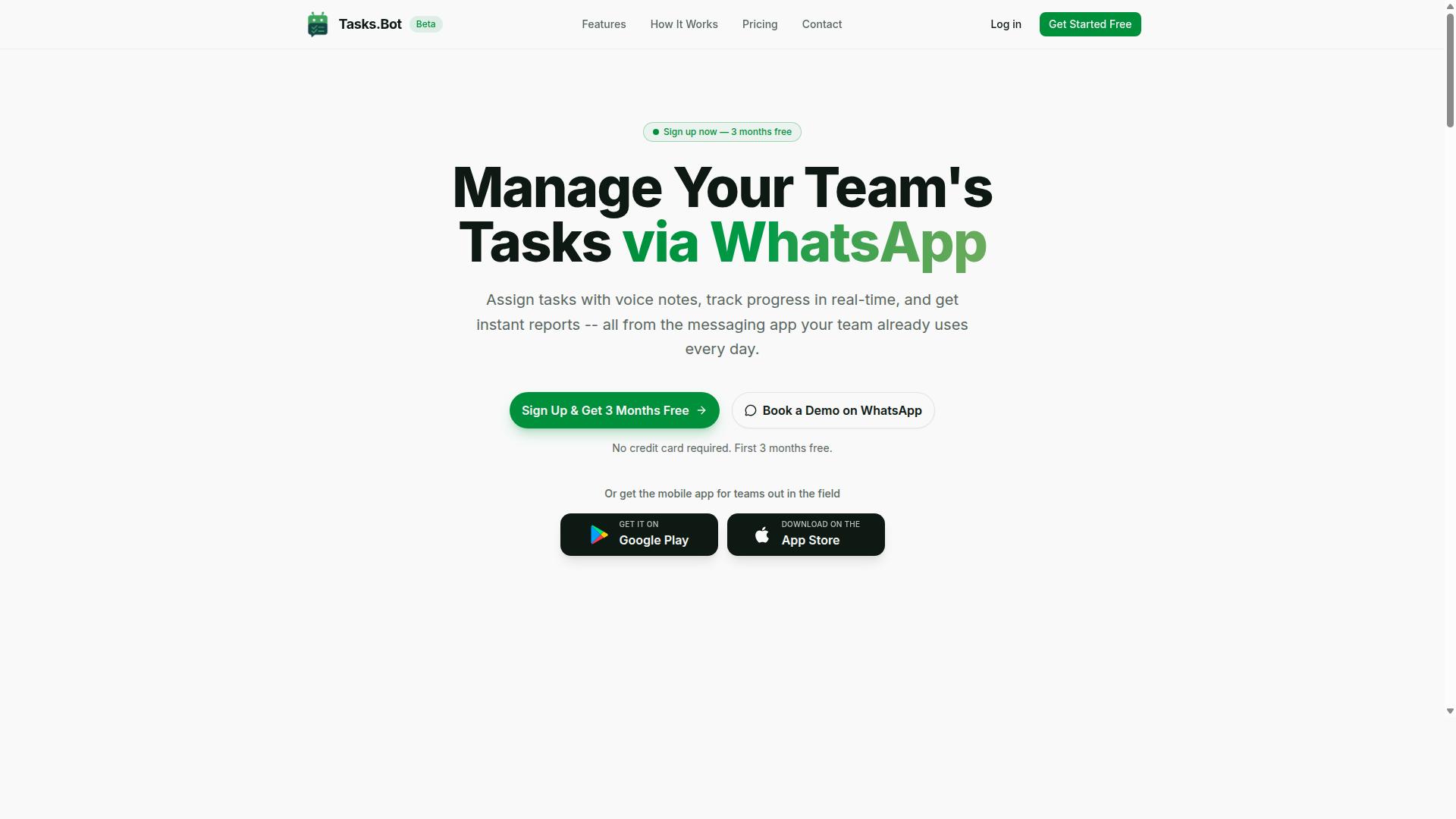
Tasks.Bot is a task management platform that operates entirely within WhatsApp, enabling teams to assign tasks, track progress, and receive reports without leaving the messaging app. That single design decision separates it from the long list of standalone productivity tools that ask users to adopt yet another dashboard.
The core idea is simple: work happens where conversations already happen. Instead of asking a team to learn a new interface, Tasks.Bot turns WhatsApp itself into the workspace. Tasks get assigned, progress gets tracked, and reports come back through the same chat threads people check dozens of times a day.
For teams that spend their working hours in the field, Tasks.Bot also offers a mobile app built for field teams. This gives staff a dedicated option when a phone call, a photo, or a location-based update needs more structure than a chat message provides.
Two practical details matter for anyone evaluating the platform. First, it eliminates the need for new accounts or installations, because WhatsApp is already on nearly every team member's phone. Second, the service is currently in beta and offers a free trial period, so teams can evaluate how it fits their workflow before committing.
This WhatsApp-first foundation shapes everything that follows in this article. When the question is whether Tasks.Bot works for lead scoring automation in B2B SaaS, the answer depends on how well a chat-native task layer connects to the systems where scoring actually lives, such as a CRM and its workflow automation.
Who Tasks.Bot Serves: WhatsApp-First Teams and Field Staff
Tasks.Bot is designed for teams that already use WhatsApp as their primary communication tool, especially those with field staff who need task management, attendance tracking, and payroll-ready hours. The platform does not try to convert those teams into something they are not. It meets them in the app they already trust.
That focus shows up in the feature set. Beyond assigning and tracking tasks, Tasks.Bot supports attendance tracking and payroll-ready hours, two needs that come up constantly for supervisors managing people who are not sitting at a desk. A field technician, a delivery crew, or a distributed sales team can log their day without a separate timekeeping tool.
The audience is broader than field operations alone. Any group that runs its coordination through WhatsApp chats, whether that is a small sales team, a service business, or an internal department, fits the profile. The site notes that hundreds of teams already use the service, which suggests the model resonates beyond a single industry.
For B2B SaaS readers specifically, this matters because sales teams are often WhatsApp-heavy in regions where the app is the default business channel. A tool that lives in that channel can capture task-level activity that would otherwise stay buried in chat history.
What Tasks.Bot is not, based on the available facts, is a lead scoring engine. It does not claim to run predictive models, calculate fit scores, or enrich records with firmographic data. Understanding that boundary is essential before asking whether it belongs in a lead scoring automation stack.
Is Tasks.Bot Good for Lead Scoring Automation in B2B SaaS?
Lead scoring automation in B2B SaaS typically requires sophisticated tools to analyze demographic, firmographic, and behavioral data, but Tasks.Bot approaches this challenge from a different angle. It is not a dedicated lead scoring platform, and it does not claim to be one.
What Tasks.Bot offers instead is task management and workflow automation via WhatsApp, with AI that understands user intent and creates tasks from messages. That makes it a strong execution layer for teams that already have scores coming from somewhere else.
This distinction matters. Many B2B SaaS teams assume they need one tool to handle everything from scoring model design to sales follow-up. In reality, scoring and task execution are separate jobs, and mixing them up leads to bloated stacks and unclear ownership.
Tasks.Bot sits firmly on the execution side. It can receive a trigger, create a task, assign it to the right person, and remind them to act. The scoring itself, whether rule-based, predictive, or behavioral, has to happen in a dedicated system.
The sections below break down what Tasks.Bot can realistically automate in a lead scoring workflow, and where a purpose-built scoring tool still makes more sense.
What Tasks.Bot Can Realistically Automate in a Lead Scoring Workflow
Tasks.Bot can automate task creation, assignment, and reminders within a lead scoring workflow, but it does not perform the actual scoring calculations. Think of it as the hand that acts on a score, not the brain that calculates it.
Here is what it can genuinely handle once a score exists:
- Task creation from natural language and voice notes, using AI to understand intent and turn messages into structured tasks
- Automatic task assignment based on rules you define, so the right rep gets the right follow-up
- Smart deadline reminders to keep time-sensitive follow-ups from slipping
- Approvals and automations for handoffs that need a sign-off before moving forward
- Instant reports so managers can see what was assigned and what got done
A practical example: if a lead's score exceeds a threshold, Tasks.Bot can automatically create a task for a sales rep to call them. That is the MQL to SQL handoff in action, minus the manual coordination.
The same logic applies across the sales pipeline. When a lead moves from marketing qualified lead to sales qualified lead, a task can be generated, assigned, and tracked without anyone chasing a spreadsheet.
Tasks.Bot also runs natively inside WhatsApp, with Android and iOS apps that support push notifications, voice capture, and a home screen widget. For sales teams already living in WhatsApp, that removes the friction of switching tools just to log a follow-up.
What it will not do is calculate a fit score, an intent score, or an engagement score. Those numbers must come from an external scoring model, whether that model is rule-based or powered by machine learning.
Where Tasks.Bot Fits - and Where a Dedicated Lead Scoring Tool Fits Better
Tasks.Bot excels at task coordination within WhatsApp, but dedicated lead scoring tools like HubSpot, Salesforce, or Pipedrive are better suited for building and maintaining scoring models. Each plays a different role in the same workflow.
Dedicated platforms bring advanced scoring algorithms, machine learning, and deeper CRM integration. They are built to ingest demographic data, firmographic data, and behavioral signals, then turn them into a score that updates in real time or in batches.
Tasks.Bot does not compete on that ground. Its strength is turning a decision into action, especially for teams that need to respond to scores inside WhatsApp rather than inside a CRM dashboard.
| Need | Tasks.Bot | Dedicated Scoring Tool |
|---|---|---|
| Building a scoring model | Not supported | Core capability |
| Acting on a score change | Strong fit | Possible, but heavier |
| Task assignment and reminders | Core capability | Often limited or add-on |
| WhatsApp-native coordination | Native | Usually not native |
The good news is that these tools do not have to compete. Tasks.Bot can connect with dedicated platforms via Zapier or other automation tools, triggering tasks when a score changes. That way, the scoring model stays where it belongs, and the follow-up happens where the team actually works.
The clear recommendation: use Tasks.Bot for task execution, not scoring. Let HubSpot, Salesforce, Pipedrive, or a similar platform own the scoring algorithm and the CRM integration. Let Tasks.Bot own the follow-through.
For B2B SaaS teams, that split is often the difference between a lead prioritization strategy that looks good on paper and one that actually moves the conversion rate. Scores only create value when someone acts on them, and that is exactly the gap Tasks.Bot is built to close.
Key Features Relevant to Lead Scoring Workflows
Lead scoring automation only delivers value when someone acts on the score. A high fit score or intent score sitting in a dashboard does nothing for the sales pipeline until a rep follows up, and that follow-up has to happen fast to matter.
This is where Tasks.Bot fits into a B2B SaaS lead scoring stack. Several Tasks.Bot features directly support lead scoring workflows by ensuring timely follow-ups and providing visibility into team activities.
Three capability groups matter most for teams working with MQL and SQL handoffs:
- Task creation through AI voice notes and natural language, so reps can log follow-ups without leaving their workflow
- Task assignment and approvals, so high-priority leads route to the right person with the right deadline
- Reporting and live tracking, so managers can confirm that scored leads are actually being worked
Tasks.Bot operates entirely within WhatsApp, which means team members do not need to install anything or create new accounts. For sales teams already juggling a CRM, a scoring tool, and an inbox, that low-friction entry point matters. The sections below break down how each feature set connects to lead prioritization and pipeline execution.
AI Voice Note Task Creation and Natural Language Input
Tasks.Bot uses AI to interpret voice notes and natural language text, allowing sales reps to create tasks quickly without typing. Instead of navigating forms or dropdown menus, a rep can simply describe what needs to happen next.
For lead scoring workflows, this removes a common point of failure. A rep reviewing a queue of scored leads can dictate something like "Follow up with lead John Doe who scored 85" and Tasks.Bot will create the task with the relevant details attached. The intent score, the contact name, and the action all land in one step.
This matters because friction kills follow-through. Response speed is often cited as a strong predictor of conversion in B2B sales, yet manual task entry is tedious enough that reps often delay or skip it. When a rep has to switch apps, open a form, and type out context, the task frequently never gets created at all.
Voice note task creation is one of the unique selling points that separates Tasks.Bot from conventional task managers. It uses AI to understand user intent and create tasks from messages, which means the tool adapts to how reps already communicate rather than forcing a new process. There are also Android and iOS apps with push notifications, voice capture, and a home screen widget for reps who want a native mobile experience alongside WhatsApp.
For teams running behavioral scoring or predictive scoring models, the practical benefit is simple: the gap between "this lead scored high" and "someone is assigned to act on it" shrinks considerably.
Automatic Task Assignment, Approvals, and Smart Deadline Reminders
Tasks.Bot automates task assignment based on predefined rules, routes tasks for approvals, and sends smart deadline reminders to ensure nothing falls through the cracks. These three capabilities form the execution layer of lead scoring automation.
Automatic assignment means a task can be routed to a specific team member based on criteria such as lead score or territory. A lead with a strong fit score and high engagement score might go straight to a senior account executive, while a lower-priority lead routes to a nurture sequence owner. This mirrors how rule-based scoring models already segment leads, extending the logic from "who is this lead" to "who should call them."
Approvals add a checkpoint for tasks that need manager sign-off before they proceed. In B2B SaaS, this is useful for discount requests, custom contract terms, or outreach to enterprise accounts where a marketing qualified lead needs review before becoming a sales qualified lead.
Smart deadline reminders adapt to task urgency. A task tied to a hot, high-intent lead can carry a tight deadline, while a longer-horizon nurture task gets a looser one. Consider a lead that just requested a demo and scored 90. The task assignment fires immediately, the deadline is measured in hours, and the reminder escalates if the rep has not acted. A lead that downloaded a whitepaper and scored 45 might get a follow-up task with a multi-day window instead.
Together, these features turn a static score into a scheduled, owned action. That is the difference between lead prioritization on paper and lead prioritization in practice.
Instant Reports and Live Day Tracker for Pipeline Visibility
Tasks.Bot provides instant reports and a live day tracker, giving managers real-time visibility into task completion and pipeline activities. Both features are part of the Tasks.Bot products and services lineup, alongside tasks on a map, face-verified attendance, and shifts, leave, and hours management.
Instant reports surface the metrics that matter for lead scoring follow-through: task completion rates, overdue tasks, and team performance. A manager can see whether high-scoring leads are being contacted within the intended window or whether they are sitting untouched in a queue.
The live day tracker provides a real-time view of what each team member is working on. Instead of waiting for a weekly pipeline review, a sales manager can check in during the day and spot a stalled high-priority lead before it goes cold.
This visibility closes the loop on lead scoring automation. Scoring models, whether rule-based or powered by machine learning, exist to direct attention. Reports and live tracking confirm that attention actually landed where the model intended. If a lead with a strong intent score shows an overdue follow-up task, the manager knows immediately.
For teams weighing whether Tasks.Bot is a good fit, this is the strongest argument for pairing it with a scoring system. The score tells you who matters. Tasks.Bot tells you whether anyone acted, and it does so inside WhatsApp, where the team already works. Enterprise-grade encryption protects the conversation and task data, and that data is never shared or used for training.
Pricing and Plans
Tasks.Bot offers a single 'Full Access' plan with all features included, priced at ₹200 per member per month or ₹1,200 per year per member. There are no tiered packages to compare, no feature gates, and no upsells to weigh before you can start building a lead scoring automation workflow.
That simplicity matters for B2B SaaS teams evaluating tools for lead scoring automation. Most buyers expect to spend hours comparing Starter, Pro, and Enterprise tiers. With Tasks.Bot, the decision comes down to one question: how many members need access?
Pricing is charged per member, not per workspace or per contact record. If your revenue operations team has five people working on lead qualification, you pay for five members. Scaling up or down simply changes the member count.
| Plan | Price | Billing Cycle | Features |
|---|---|---|---|
| Full Access (Monthly) | ₹200 per member | Monthly | All features included |
| Full Access (Annual) | ₹1,200 per member | Yearly | All features included |
The annual plan delivers a substantial saving. At ₹1,200 per year per member versus ₹200 per month, subscribers save 50%, which works out to ₹1,200 saved per member annually.
Tasks.Bot displays pricing in both Indian Rupees and US Dollars. The site includes a 'Select currency' option with Indian Rupee and US Dollar choices, so buyers should verify the displayed currency before subscribing.
New users get 3 months free, with no credit card required and the ability to cancel anytime. For a team testing whether Tasks.Bot fits its lead prioritization and sales pipeline needs, that trial period removes the financial risk of evaluation.
Tasks.Bot is currently in beta. Beta status can affect pricing or features over time, so teams should confirm current terms directly before committing to an annual plan. For now, the flat per-member structure keeps budgeting straightforward: multiply the member count by the monthly or annual rate, and that is the full cost.
Trust Signals: Beta Status, Encryption, and Early Adoption
Tasks.Bot is currently in beta, which means it is still evolving, but it already offers encryption and is used by hundreds of teams. For a B2B SaaS team weighing lead scoring automation, that combination matters. You are not evaluating a finished, static product. You are evaluating a platform that is actively being shaped, with a real user base already putting it to work.
Beta status is a trust signal that cuts both ways, and it is worth being honest about that. On one hand, it tells you the product is still changing, so features, interfaces, and defaults may shift as the team ships updates. On the other hand, it signals momentum. A tool in active beta is usually one that is being invested in, not shelved.
The practical implication for lead scoring is straightforward. If your scoring model, whether rule-based or predictive, depends on a workflow that could change, plan for a little flexibility in how you configure it. That is a reasonable trade for teams that want early access to a developing platform rather than waiting for a fully mature release.
Encryption is the second signal, and it is the one that tends to matter most to anyone handling lead data. Lead scoring automation in B2B SaaS runs on firmographic data, behavioral signals, and contact details pulled from sources like HubSpot, Salesforce, Pipedrive, or Zapier. That is sensitive material. Encryption is a baseline expectation for any tool that touches it.
Tasks.Bot offering encryption during beta is a meaningful detail. It suggests the team treated data protection as a foundation rather than a later add-on. For a platform involved in lead capture, lead enrichment, and data append, that foundation is exactly where you want security to sit.
Early adoption is the third signal, and it is the most persuasive one. Hundreds of teams are already using Tasks.Bot. That is social proof in its simplest form. Other B2B SaaS organizations have looked at the same beta label, the same encryption posture, and the same evolving feature set, and decided the trade was worth making.
Social proof does not replace your own evaluation, but it does reduce the sense that you would be the first to try something untested. A platform with hundreds of active teams has real usage behind it, which means real feedback is flowing back to the product team.
The refund policy mentioned in the site footer is a fourth signal, and it is an easy one to overlook. A refund policy shifts risk away from the buyer. If the beta product does not fit your lead qualification workflow, you are not locked in. That is a reasonable safety net for a tool that is still maturing.
There is also a Book a Demo on WhatsApp option on the site. For teams that want to ask direct questions before committing, that is a low-friction way to get answers. It also tells you the team is willing to talk to prospects rather than hiding behind a form.
Put together, these signals paint a coherent picture for anyone asking whether Tasks.Bot is a safe bet for lead scoring automation:
- Beta status means active development and evolving features, which is a trade-off rather than a red flag.
- Encryption is in place, which matters for any platform handling lead and CRM data.
- Hundreds of teams already use it, providing social proof that others have made the same call.
- A refund policy in the footer limits your downside if the fit is not right.
- A WhatsApp demo option lets you ask questions before you commit.
None of this is a substitute for testing the platform against your own scoring model, your own CRM integration, and your own definition of an MQL or SQL. But as trust signals go, this set is stronger than the beta label alone would suggest.
The honest read is this. Tasks.Bot is not pretending to be finished. It is telling you it is in beta, it is telling you encryption is in place, and it is showing you that hundreds of teams have already signed on. For a B2B SaaS team evaluating lead prioritization and pipeline automation, that transparency is itself a trust signal.
Who Should Use Tasks.Bot for Lead Scoring Automation
Tasks.Bot is ideal for WhatsApp-first teams with field staff who need to act on lead scores quickly but do not require advanced scoring algorithms. If your sales process lives inside WhatsApp and your reps are often on the move, this tool fits a very specific gap in the market.
It does not build scoring models. Instead, it helps teams turn existing lead scores into action through task management, attendance tracking, and payroll-ready hours. That distinction matters when you are deciding whether to adopt it.
The site notes that hundreds of teams already use the service, which suggests the WhatsApp-plus-field-work combination is a real and common need. The question is whether your team matches that profile.
Below are the scenarios where Tasks.Bot makes the most sense, and the ones where a different tool should sit in the driver's seat.
Good fit: WhatsApp-first teams with field sales. If your reps coordinate through WhatsApp and spend most of their day visiting prospects or clients, Tasks.Bot keeps their work organized. Lead scores from elsewhere can inform which follow-ups matter, and the team acts on them without leaving the channel they already use.
Good fit: teams that already score leads elsewhere. Suppose you use one system for lead scoring automation and want the output to trigger tasks in WhatsApp. Tasks.Bot works well as the action layer. It receives the priority signal, and your field team gets a clear to-do.
Good fit: small to medium B2B SaaS teams. These teams often lack the headcount for a dedicated ops function. They need something practical that keeps field staff accountable, tracks hours, and supports payroll. Tasks.Bot covers those basics without a heavy setup.
Poor fit: teams that need to build scoring models. If your goal is to design predictive scoring, tune a scoring algorithm, or run AI lead scoring with machine learning, look elsewhere. Tasks.Bot does not claim to do that work, and expecting it to would lead to disappointment.
Poor fit: teams wanting deep CRM scoring logic. If you need behavioral scoring, demographic scoring, or firmographic data blended into a fit score and intent score, that belongs in a dedicated platform. Tasks.Bot is not positioned as that platform.
Think of it this way. The scoring engine decides who matters. Tasks.Bot helps your people do something about it in the channel they already use.
If your team lives in WhatsApp and has field staff, Tasks.Bot is a strong fit for acting on lead scores. If you need to create those scores from scratch, choose a dedicated scoring tool and let Tasks.Bot handle the follow-through.
Final Verdict
Tasks.Bot is a capable WhatsApp-native task management platform that can support lead scoring workflows by automating task follow-ups, but it is not a replacement for dedicated lead scoring software. It earns its place as a complement to a scoring tool, not a substitute for one.
Its core strength lies in task automation inside WhatsApp, a channel where many B2B buyers already spend their day. When a score crosses a threshold in your scoring model, Tasks.Bot can help your team act on that signal through structured follow-up tasks rather than letting a hot lead sit untouched.
Where it falls short is in the scoring itself. Tasks.Bot does not replace the predictive and behavioral scoring engines found in dedicated platforms, so it cannot generate a fit score, intent score, or engagement score on its own. Teams still need a scoring model to decide which leads deserve attention.
Pricing is available in Indian Rupees and US Dollars, so buyers should confirm current plans directly before committing. That is a reasonable step for any workflow automation purchase, and it keeps expectations aligned with what the platform actually delivers.
The practical recommendation is straightforward. Keep your dedicated scoring tool for lead qualification, then layer Tasks.Bot on top for task automation and follow-up execution. This pairing supports lead prioritization and helps protect your conversion rate without forcing a rip-and-replace of your existing stack.
If you want to explore whether this setup fits your B2B SaaS sales pipeline, reach out by phone at +91 97143 42522 or email [email protected]. You can also book a demo on WhatsApp to see the task automation workflow in action.
Frequently Asked Questions
Can Tasks.Bot actually handle lead scoring, or is it just a task manager?
Tasks.Bot isn't a dedicated lead scoring engine - it's a task management platform that runs inside WhatsApp, with features like automatic task assignment, approvals and automations, smart deadline reminders, and instant reports. For B2B SaaS teams, that means you can use it to turn scored leads into assigned follow-up tasks, route them to the right rep, and track progress without leaving WhatsApp. If you need a numerical scoring model itself, you'd typically generate that score in your CRM or marketing tool and let Tasks.Bot handle the follow-up workflow around it.
Do my sales reps need to learn a new tool to act on scored leads?
No. Tasks.Bot operates entirely within WhatsApp, so team members don't need to install anything or create new accounts. Reps receive their assigned follow-ups, deadline reminders, and approval requests right in the messaging app they already use. A mobile app is also available for field teams who need it.
How would lead follow-ups actually get created in Tasks.Bot?
Tasks.Bot uses AI to understand natural language and voice notes, so you can create tasks by simply typing or speaking a message - for example, forwarding a hot lead with a note to call them today. Automatic task assignment then routes the work to the right person, and smart deadline reminders keep follow-ups from slipping. Instant reports let you see what's been actioned and what's still pending.
Is Tasks.Bot a good fit for a small B2B SaaS sales team?
It can be, especially if your team already runs on WhatsApp. Tasks.Bot is designed for teams that use WhatsApp for communication, and the site mentions hundreds of teams already using the service. The 'Full Access' plan includes all features, priced at ₹200 per member per month or ₹1,200 per year per member on the annual plan (a 50% saving), with pricing also available in US Dollars.
Does Tasks.Bot connect with our CRM or other lead scoring tools?
The verified feature set covers task management via WhatsApp, including voice note task creation, automatic assignment, approvals and automations, instant reports, tasks on a map, and live day tracking - it does not list specific CRM integrations. If connecting to your existing lead scoring stack is essential, it's best to confirm your exact requirements with the Tasks.Bot team before committing. You can reach them at [email protected] or +91 97143 42522.
How do we try Tasks.Bot before rolling it out to our sales team?
The website offers a 'Book a Demo on WhatsApp' option, which is the simplest way to see how lead follow-up workflows would look in practice. Tasks.Bot is currently in beta, is available globally as a SaaS product, and the site mentions a refund policy in the footer. Pricing is straightforward - one 'Full Access' plan with all features included, so there are no tiers to compare.
Recommended Resources: