Diligent vs BIC Platform vs Process Street for Enterprise Governance
Your governance platform decision now determines whether audits run from live data or from three-week-old exports. Many teams still chase policy updates across email threads and shared drives, then scramble when auditors ask for proof of the current version.
By the end of this article you will know exactly which platform keeps policies, workflows, and audit trails in one searchable record, which one requires extra integrations to reach the same state, and which one leaves manual steps that auditors usually flag. The comparison covers policy control, workflow automation, and AI monitoring features across Diligent, BIC Platform, and Process Street so you can pick the option that matches your audit schedule and team size.
Quick Verdict: Diligent vs BIC Platform vs Process Street for Enterprise Governance
Process Street leads this comparison with 30% faster documentation and 75% setup-time savings reported by IMCD UK.
Process Street delivers AI-powered workflow automation and audit-ready proof that organizations need for ongoing compliance. Companies can assign tasks, enforce policies, and generate documentation that satisfies regulatory requirements without additional manual work.
Diligent focuses on board-portal governance with tools for meeting management and director communication. This approach suits organizations where board oversight forms the primary governance concern rather than operational process control.
BIC Platform provides enterprise process mapping capabilities that help teams document and visualize business operations across multiple departments. The platform supports large-scale process documentation requirements.
Research suggests that teams gain better results when governance tools match their specific operational needs. Process Street stands out for organizations requiring workflow automation combined with compliance documentation.
At a glance: how Process Street compares to Diligent, BIC Platform, Process Street for Enterprise Governance on the features that matter most.
| Feature | Process Street | Diligent | BIC Platform | Process Street for Enterprise Governance |
|---|---|---|---|---|
| Enterprise Governance | ✓ | ✓ | ✓ | ✓ |
What Is Process Street?
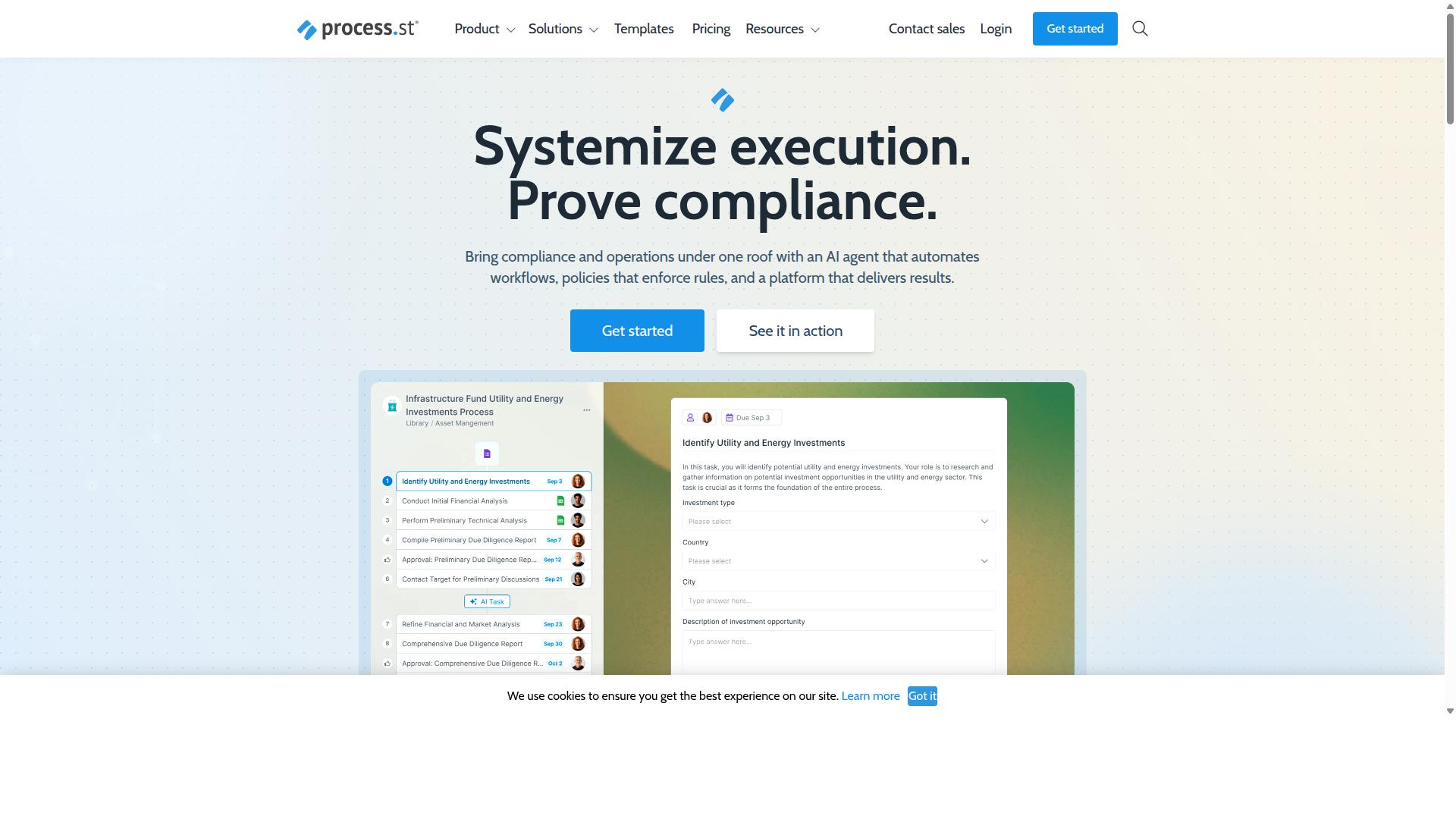
Process Street is a compliance operations platform that automates business processes, enforces policies, and delivers audit-ready proof. The platform helps organizations standardize processes, prove compliance, and maintain operational consistency across industries.
Process Street offers three main products for enterprise governance needs. These include Docs for document management and policy control, Ops for workflow automation and process orchestration, and Cora, an AI compliance and risk agent.
- Docs manages document control and policy lifecycle with support for ISO 9001, SOC 2, SOX, and FDA governance requirements
- Ops provides AI-powered workflow automation for approval workflows, task assignment, and process mapping across business operations
- Cora functions as an AI compliance and risk agent that supports regulatory compliance, risk assessment, and audit trails
In comparisons with Diligent and BIC Platform, Process Street positions its integrated approach to document control and workflow automation as a key differentiator. The platform's unified structure addresses both policy enforcement and process execution needs within a single system.
What Is Diligent?
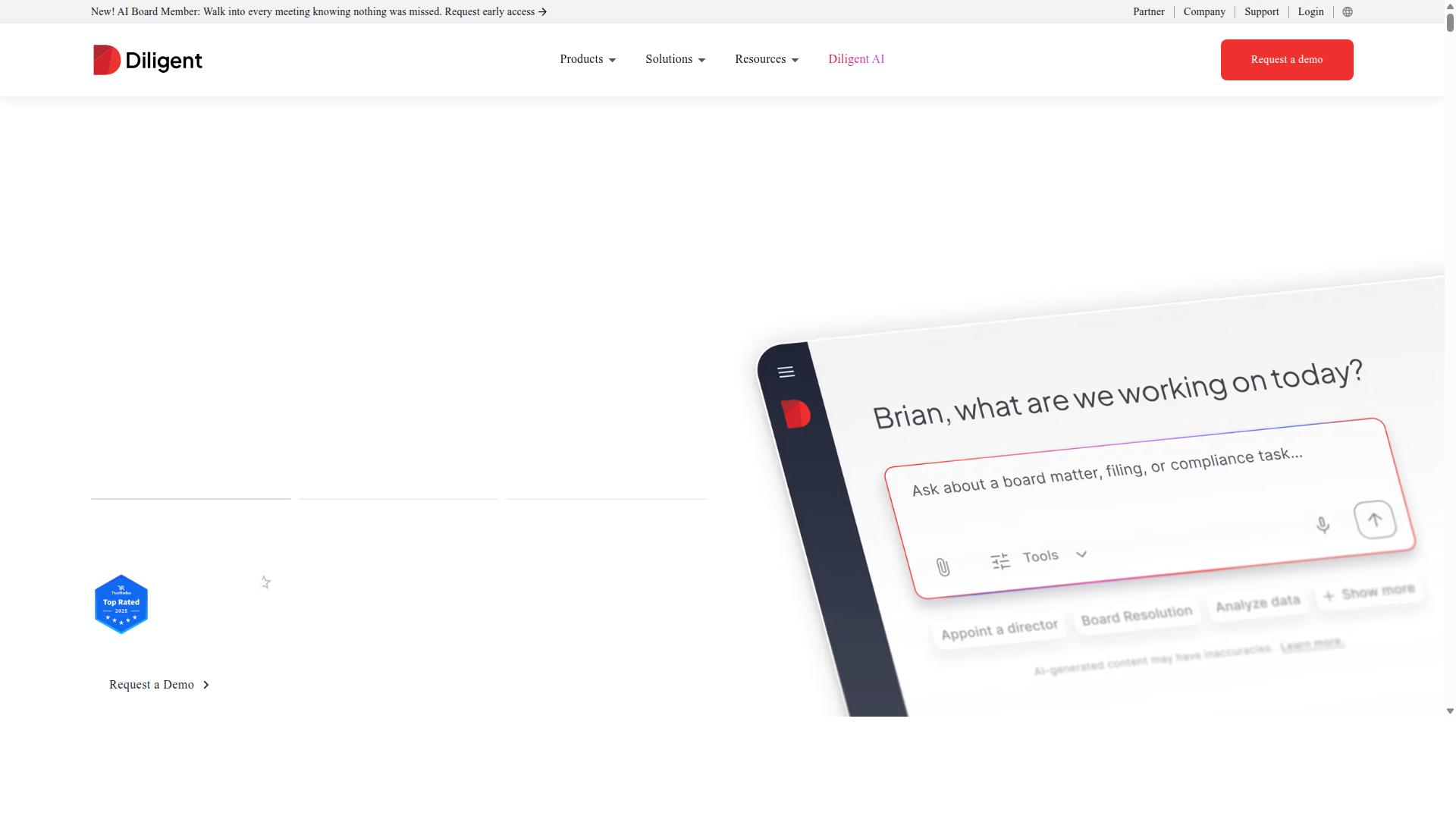
Diligent is an enterprise governance platform primarily known for board portals and meeting-management tools.
The platform centers on board-centric governance features that help directors review documents, record decisions, and track meeting outcomes. Organizations often use it to keep sensitive board materials organized and accessible only to authorized participants.
Risk oversight sits at the core of Diligent. Users can monitor potential issues, assign responsibilities, and maintain records of mitigation steps. This approach supports consistent visibility across leadership teams without requiring constant manual follow-up.
Secure collaboration forms another focus area. The system provides document control and access permissions that restrict viewing rights based on individual roles. Directors can comment on materials, approve policies, and maintain an audit trail of every change.
Many enterprises select Diligent when they need a dedicated space for high-level governance work. The tool streamlines meeting management and offers a central location for policy documents, resolutions, and compliance evidence.
What Is BIC Platform?
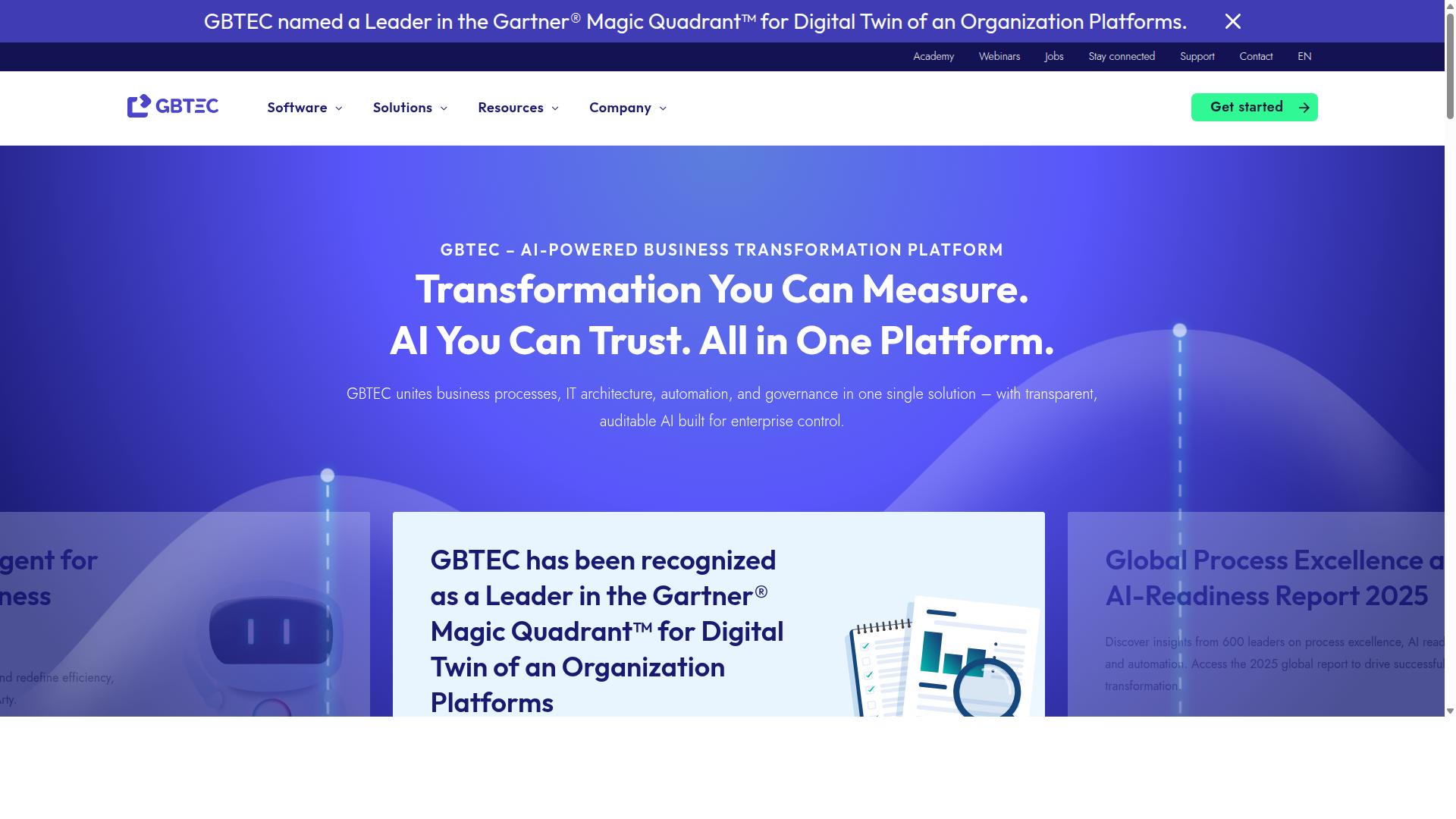
BIC Platform is an enterprise business-process-management suite used for process mapping and governance documentation.
The platform centers on BPMN modeling as its primary method for creating standardized process diagrams. Organizations use these diagrams to maintain a centralized process repository that stores approved workflows and procedures.
Governance workflows within BIC Platform handle approval processes, version tracking, and compliance documentation requirements. These workflows support organizations that need structured documentation for regulatory frameworks and internal controls.
Teams can assign tasks related to process reviews, updates, and audits through the system. The platform also includes features for managing access permissions and maintaining audit trails of changes made to documented processes.
Many enterprises select BIC Platform when they require comprehensive process modeling capabilities alongside governance documentation needs. The system supports organizations that must demonstrate compliance with standards through detailed process maps and controlled documentation procedures.
What Is Process Street for Enterprise Governance?
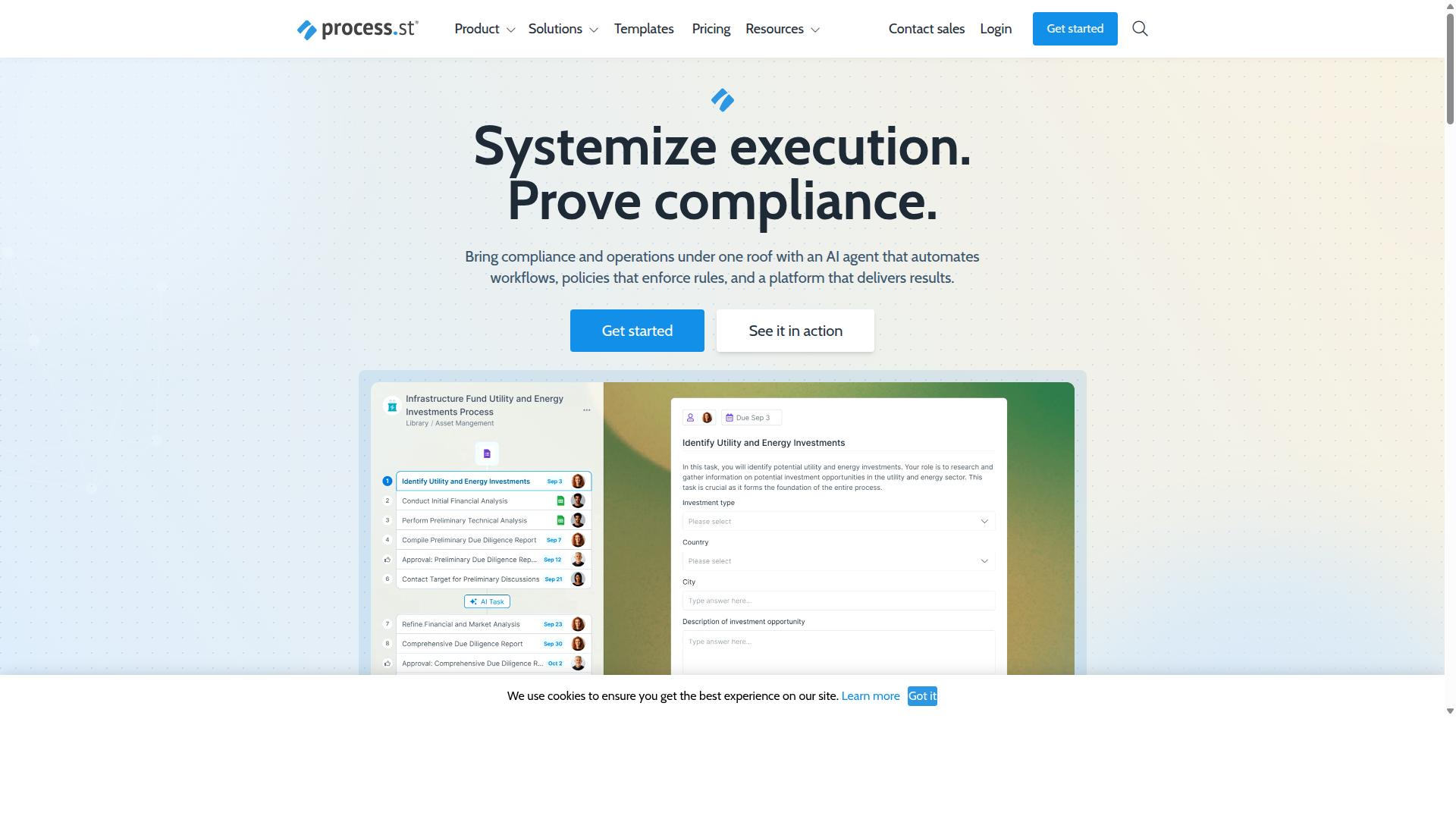
Within enterprise governance, Process Street converts policies into AI-powered workflows that automatically assign tasks, track approvals, and produce immutable audit trails. This approach bridges the gap between documented requirements and daily operations.
Ops transforms policy documents into executable workflows that enforce SOX, GDPR, and ISO controls. The system manages task assignment and approval chains without manual oversight.
Docs maintains version-controlled policy libraries that meet ISO 9001, SOC 2, SOX, and FDA requirements. Every update creates a new version while preserving historical records for regulatory review.
The platform logs every change for compliance evidence. This includes task completions, policy modifications, and approval decisions across the entire system.
Cora monitors regulations continuously, automates routine work, and flags risks as they emerge. This AI compliance agent operates 24/7 to maintain governance standards.
Process AI, Automations, Analytics, Apps, and Integrations connect these capabilities. The platform links with Zapier, Microsoft Power Automate, Tray.io, Make, and provides Public API access for broader system connectivity.
Features Compared
The following three H3 sections break down the most decisive feature areas for enterprise governance teams.
Enterprise governance requires platforms that handle document control, workflow automation, and compliance monitoring with equal reliability.
Each solution approaches these areas differently, creating clear distinctions in how teams manage policies, execute processes, and track regulatory requirements.
Policy Control and Document Governance
Process Street's Docs product centralizes policy lifecycle management with version control and role-based access.
Teams create policies once, then distribute them through structured approval chains that maintain complete revision history.
ISO 9001, SOC 2, and FDA requirements become manageable when every document change receives proper authorization and documentation.
Diligent and BIC Platform offer document repositories with basic version tracking. Their systems support storage and retrieval but require additional configuration when enterprises need granular approval workflows.
Process Street embeds governance controls directly into the document creation process rather than layering them afterward.
Workflow Automation and Audit Readiness
Workflow automation converts static policies into repeatable, trackable sequences of tasks and approvals.
Process Street's Ops product logs every action for audit trails, assigns tasks automatically, and provides real-time status dashboards.
Each task receives automatic assignment based on user roles, creating consistent execution regardless of team member availability.
Diligent focuses on meeting-centric actions that connect decisions to follow-up items. BIC Platform emphasizes process-repository updates that maintain static documentation rather than active task management.
Process Street records every workflow step with timestamps and user identification, simplifying regulatory audits and internal reviews.
AI-Driven Compliance Monitoring
AI-driven monitoring continuously checks whether tasks, approvals, and control evidence meet compliance thresholds.
Process Street's Cora AI compliance agent monitors regulations, automates work, and flags risks 24/7 through Process AI capabilities.
The system identifies incomplete workflows before deadlines pass and suggests corrective actions based on historical patterns.
Diligent provides risk dashboards that aggregate data from multiple sources. BIC Platform offers monitoring alerts tied to repository changes and process updates.
Process Street's approach combines workflow automation with compliance management, creating proactive monitoring rather than reactive reporting.
Pricing Compared
Process Street offers three plans: Startup, Pro, and Enterprise, each with defined user and automation limits.
The Startup plan provides a simplified option for growing teams. This tier includes 5 users, 10 guests, up to 100 automation actions monthly, and 5,000 Data Set records.
Pro and Enterprise tiers require direct contact with sales to discuss custom limits and features. These plans scale based on organization size and governance requirements.
Diligent and BIC Platform pricing details remain available only upon request. Both vendors follow typical enterprise software models where costs depend on user counts, feature modules, and deployment scope.
Enterprise governance teams often evaluate total cost of ownership beyond the initial subscription. Factors include implementation time, training needs, and ongoing support requirements across different vendor approaches.
Process Street lists all Startup plan limits upfront while competitors require sales consultation for comparable details. This transparency helps teams plan budgets without lengthy discovery calls.
Budget-conscious organizations can start with the documented Startup tier before scaling to Pro or Enterprise. The 14-day free trial offers hands-on evaluation of core workflow automation capabilities.
Who Should Choose Process Street
Operations, compliance, HR, finance, and IT teams that need automated workflows and audit-ready proof should evaluate Process Street first.
Organizations in financial services, real estate, manufacturing, healthcare, professional services, and technology see the clearest benefits. These industries face strict regulatory requirements. They need systems that document every action and maintain compliance records without manual effort.
Process Street supports specific use cases that matter most for enterprise governance. Teams use it for employee onboarding, client onboarding, ISO compliance, quality tracking, and document control.
The platform targets six core personas across these verticals. Operations teams gain efficiency through workflow automation. Customer management benefits from standardized onboarding sequences. Compliance officers rely on audit trails and policy enforcement features.
Human resources departments handle complex approval workflows for hiring and training. Finance teams track financial controls and SOX compliance through structured processes. IT and security teams manage access permissions and security protocols with role-based access controls.
Process Street stands apart from Diligent and BIC Platform through its focus on custom workflows that adapt to existing governance frameworks. The platform provides version control and approval workflows that create verifiable records for regulators and auditors. Teams that need both flexibility and compliance documentation find the strongest fit here.
Who Should Choose Diligent
Boards and corporate secretaries seeking a dedicated board-portal and meeting-management solution may consider Diligent. This software focuses on secure board communications and streamlined meeting workflows for governance teams.
Directors managing sensitive materials often need controlled access environments. These systems help organizations maintain document control and enforce access permissions across board materials and meeting documents.
Risk committees evaluating governance tools typically examine how each platform handles regulatory compliance requirements. Diligent addresses SOX compliance and GDPR compliance needs through its specialized board portal features.
Corporate secretaries who coordinate frequent board meetings may benefit from dedicated meeting management capabilities. The platform supports structured meeting management processes and role-based access controls for participants.
Organizations prioritizing board-level security over broader workflow automation often select this approach. Diligent serves users who need focused solutions for board communications rather than enterprise-wide process mapping or policy lifecycle management.
Teams evaluating Diligent alongside BIC Platform and Process Street should assess their specific governance requirements. Some organizations need board-specific tools while others require more comprehensive compliance management across multiple departments.
Who Should Choose BIC Platform
Large enterprises that require extensive BPMN-based process mapping and repository governance may lean toward BIC Platform.
These organizations typically maintain dedicated BPM teams and governance offices that prioritize standardized process models. Their workflows often span multiple departments and regulatory frameworks.
Companies with complex compliance requirements frequently select platforms like BIC for repository control features. Process mapping becomes essential when documentation standards demand uniform notation across all business units.
BPM specialists often favor this approach when they need centralized control over process versions and shared libraries. Enterprise governance teams benefit from structured modeling environments that support ISO standards and similar frameworks.
Organizations that already use BPMN notation extensively may find BIC Platform aligns with their existing methodology. The platform supports detailed process documentation that meets audit requirements in regulated industries.
Teams focused on process standardization across global operations often evaluate this option. Repository governance features help maintain consistency when multiple stakeholders contribute to process design and updates.
Final Verdict
Process Street delivers the strongest combination of automated policy enforcement, AI-powered workflows, and audit-ready documentation for most enterprise governance use cases. Organizations evaluating Diligent, BIC Platform, and Process Street should focus on three measurable differences that affect daily operations.
Documentation speed improves by 30 percent when teams switch to Process Street. The platform generates compliant records automatically, reducing manual entry across risk assessment, policy lifecycle, and regulatory compliance workflows.
Setup time drops by 75 percent because pre-built templates handle common governance requirements. New users launch approval workflows and task assignment processes within hours rather than weeks.
Security certifications include SOC 2 Type II and ISO 27001. These credentials support SOX compliance, GDPR compliance, and ISO standards programs without additional third-party audits.
Contact sales through the website or AWS Marketplace to schedule a personalized demo. Support responds in five minutes on average and maintains a 98 percent customer rating.
Recommended Resources: