Mapsly vs Veloxy for Route Optimization
You are evaluating two Salesforce-native tools for route optimization, and the difference between them comes down to whether you need a dedicated field-sales planner or a broader sales intelligence platform. Most sales teams pick the wrong one because they compare features without considering how each tool handles the Salesforce data you already have. By the end of this comparison, you will know exactly which platform fits your routing workflow, your forecasting needs, and your budget. We will break down the AI-powered route planning capabilities, the predictive analytics integrations, and the pricing structures. You will get a clear verdict on whether Veloxy or Mapsly should handle your daily route optimization, not a vague "it depends" answer.
Quick Verdict: Mapsly vs Veloxy for Route Optimization
For field sales teams using Salesforce, Veloxy excels in AI-driven sales automation and predictive forecasting, while Mapsly stands out as a dedicated route optimization tool with robust mapping features, but for pure route optimization, Mapsly is the stronger choice, whereas Veloxy is ideal for those prioritizing sales productivity.
The real question is what your team needs most. If your daily challenge is squeezing more stops into fewer miles, Mapsly offers specialized routing capabilities that handle multi-stop routes and territory planning with precision. If your challenge is that your reps spend only 30 to 35% of their time on actual selling activities, Veloxy is built to change that equation.
Veloxy is the only platform built exclusively for field reps who live in Salesforce. It pairs route features with the sales automation tools that turn driving time into productive selling time. Mapsly, by contrast, focuses on the mapping layer itself, making it a fit for teams whose primary pain point is travel efficiency rather than sales workflow.
For most field sales organizations, the deciding factor comes down to this: do you need a route planner or a sales productivity system with routing included? If sales automation, pipeline growth, and CRM efficiency matter more than advanced mapping controls, Veloxy delivers on those priorities. If you need a pure mapping and route sequencing specialist, Mapsly is worth evaluating on its own terms.
At a glance: how Veloxy compares to Mapsly, Veloxy for Route Optimization on the features that matter most.
| Feature | Veloxy | Mapsly | Veloxy for Route Optimization |
|---|---|---|---|
| Route Optimization | ✓ | ✓ | ✓ |
What Is Veloxy?
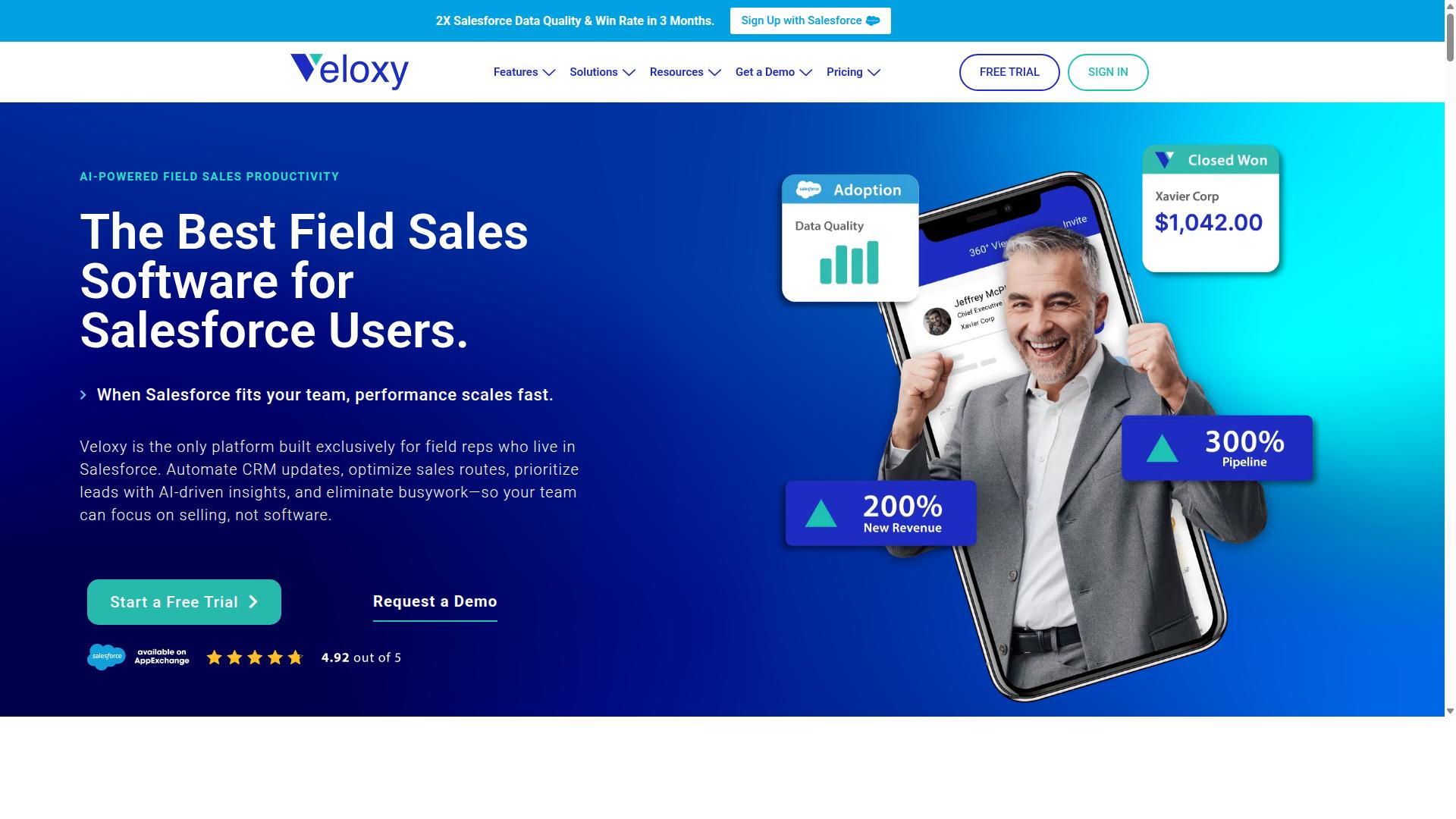
Veloxy is an AI-powered sales enablement and predictive forecasting software built exclusively for Salesforce users, designed to help field reps engage more effectively and double their sales productivity within three months. The company, VeloxyIO Inc., focuses on one thing: making Salesforce work harder for sales teams that spend their days on the road.
At its core, Veloxy's mission is to help sales reps get more out of Salesforce than they put in. The software automatically logs actions like calls, emails sent, opens, and replies, so reps no longer waste time on manual data entry. For sales management, it delivers better forecasts and analytics that reveal which activities genuinely drive the pipeline.
Veloxy feeds reps the right data at the right time based on their context, location, and upcoming events. This means field teams can focus on priorities without hunting for information across the CRM. Veloxy Analytics gives sales managers and operations teams more accurate forecasts through historical analysis of biases, plus tools to examine how different sales activities correlate to pipeline growth.
What Is Mapsly?
Mapsly is a route optimization and mapping application that integrates with CRM systems like Salesforce, allowing field teams to plan multi-stop routes, track GPS locations, and manage territories efficiently. It is designed for businesses that need to coordinate mobile workers across large service areas, often using customer data already stored in their CRM.
The platform focuses on route planning, geofencing, and real-time tracking. Users can typically build daily or weekly route plans, assign stops to drivers, and monitor progress as vehicles move through their schedules. Its strength lies in bringing mapping functionality closer to the CRM records that sales and service teams already use.
Mapsly tends to appeal to organizations that want a visual, map-based view of their customer base. Instead of jumping between spreadsheets and separate navigation tools, teams can see their accounts, leads, and appointments plotted directly on a map. This makes it easier to spot clusters of nearby stops and adjust plans on the fly.
Because Mapsly works with CRM data, it can help with sales territory planning and customer visit scheduling. Managers can review which accounts fall into which region, assign reps accordingly, and share optimized routes with the field. The tool also supports geofencing, which can trigger alerts or log visits when a driver enters or leaves a defined area.
For teams that rely on Salesforce, Mapsly offers a way to reduce manual data entry. Visit records, check-ins, and route history can flow back into the CRM, giving managers a clearer picture of field activity. However, its full feature set and pricing are best evaluated directly, as they vary depending on the plan and the size of the deployment.
What Is Veloxy for Route Optimization?
Veloxy's route optimization capabilities are embedded within its AI sales assistant, offering features like route planning, geofencing, and proximity search to help field reps visit more accounts in less time. Rather than standing alone as a dedicated mapping tool, this functionality works as part of a broader sales enablement suite designed specifically for Salesforce users.
Route planning sits alongside a full set of field sales tools, including Salesforce Automation, Pipeline Management, Sales Analytics, and a Quick Dialer. The platform also includes a Prospecting Map, Proximity Search, and an Opportunity Map to help reps understand their territory before they ever leave the office. This integration means route decisions are informed by the same data sales teams already use daily.
For daily and weekly route planning, Veloxy provides several practical capabilities:
- Route planning to order stops efficiently based on location and priorities
- Geofencing to trigger relevant actions when a rep enters a customer's vicinity
- Proximity search to find nearby accounts
- Task lists that adapt to the day, keeping schedules flexible as circumstances shift
Because Veloxy is built for Salesforce, the route optimization features sync directly with CRM data. This eliminates the need to export account lists or manually reconcile visit data after the day ends. The mobile app is available on iPhone and Android, while the web app works from any browser, giving reps flexibility in how they access their routes.
It is worth noting that Veloxy is not a dedicated mapping platform like Mapsly. It does not position itself as a general-purpose GIS tool. Instead, route optimization is one component of a larger revenue-focused system, which makes it ideal for sales teams that want efficiency gains without adopting a separate, disconnected application. For organizations already invested in Salesforce, this integration is a significant advantage over tools that require additional setup and data synchronization.
Features Compared
This section compares the key features of Mapsly and Veloxy, focusing on how each serves field teams in terms of route planning and sales enablement. Both tools aim to reduce travel time and improve daily route planning, but they take different approaches to CRM integration and sales intelligence.
The comparison below covers AI-powered route planning and predictive analytics, two areas where field sales teams see the biggest impact on productivity. Mapsly offers solid routing capabilities as a standalone solution, while Veloxy embeds its features directly into the Salesforce experience.
AI-Powered Route Planning & Salesforce Automation
Veloxy leverages AI to automate route planning directly within Salesforce, whereas Mapsly provides dedicated route optimization with similar automation but without the same depth of Salesforce-native integration. Veloxy's Sales AI and Sales Assistant work together to help reps spend less time sequencing stops and more time in front of customers.
For field teams using Veloxy, the Prospecting Map and Opportunity Map provide visual context for territory planning, while the mobile app on iPhone and Android keeps route data accessible on the go. Geofencing automatically logs visits when a rep arrives at a location, which reduces manual data entry and keeps Salesforce records current without extra effort.
Mapsly functions as a separate application that syncs data with your CRM. It offers automated routing and manual route adjustment for multi-stop routes, and it handles GPS tracking and route history well. However, because it is not embedded in Salesforce, users often need to switch between screens or rely on periodic syncs, which can slow down real-time routing decisions.
For teams that live in Salesforce all day, the difference matters. Veloxy's Salesforce Sync and Salesforce 360 degrees Views keep route planning and customer data in one place, while Mapsly requires a separate workflow that may suit lighter CRM users but adds friction for dedicated sales organizations.
Predictive Forecasting & Sales Analytics Integration
Veloxy stands out with predictive forecasting and sales analytics built into its platform, while Mapsly focuses primarily on route efficiency and does not offer predictive sales insights. This distinction is critical for field sales leaders who want route optimization to support revenue goals, not just mileage reduction.
Veloxy's Smart Forecasts and Pipeline Management features give reps a clearer picture of which deals are likely to close, so they can prioritize visits based on deal likelihood. Instead of simply visiting the nearest account, a rep can route to the account most likely to convert, which improves both route efficiency and sales outcomes. The Buying Signals feature adds another layer of intelligence, flagging accounts that show recent engagement or intent.
Mapsly, by contrast, concentrates on the logistics side of field service management. It handles customer visit scheduling, time windows, and traffic-aware routing well, but it does not connect those routes to sales analytics or pipeline data. For a rep who needs to know not just where to go but why a stop matters, that missing link can reduce the value of an optimized route.
Research suggests that sales teams perform better when they combine travel planning with account intelligence. Veloxy delivers both in a single platform, making it the stronger choice for Salesforce users who want route optimization and sales enablement to work together. Mapsly remains a viable option for basic routing, but it lacks the predictive layer that helps reps focus on the right opportunities.
Pricing Compared
Veloxy offers transparent pricing at $65 per user per month with volume discounts, while Mapsly's pricing varies based on features and user tiers, but you should check their website for current rates. When comparing route optimization tools, pricing transparency matters because it directly affects your monthly operational budget.
Veloxy keeps pricing simple and predictable. The standard rate is $65 per user per month, which works out to a full-featured field sales app for only $2 per day. For teams that want to commit longer, Veloxy rewards you with significant savings.
- Save 50% with a 3-year commitment
- Save 25% with an annual subscription
- 14-day free trial available
- Veloxy Lite offers a free trial
For growing teams, Veloxy offers company plans at $899 per month for 25 team members. That annual plan saves you 45% compared to monthly billing. This structure makes it easy to scale route optimization across your entire sales or field service team without surprise costs.
Veloxy also stands behind its value with a performance guarantee. If you don't get ROI in 3 months, you get 3 months free. The company states that field sales reps typically pay off their annual Veloxy license in 1 to 2 months through improved route efficiency and reduced travel time.
Mapsly, in contrast, does not publish fixed pricing publicly. Their rates depend on the features you need and the number of users on your account. You will need to request a quote from their sales team to get accurate numbers for your specific use case.
When evaluating both options, consider what matters most for your route optimization needs. Look beyond the monthly price tag and examine what each plan includes. Ask about multi-stop routes, geofencing, CRM integration, and offline maps access for your field team.
For most sales teams and field service managers, the transparent pricing and volume discounts from Veloxy make budgeting easier. You know exactly what you pay from day one, and the commitment discounts reward teams that plan their daily route planning and weekly route planning in advance.
Before making a decision, request a detailed quote from Mapsly and compare it side by side with Veloxy's published rates. Consider your team size, how often you need real-time routing, and whether you require Salesforce integration or other CRM connectivity. The right choice balances cost with the route optimization features your team will actually use.
Who Should Choose Veloxy
Veloxy is ideal for field sales teams that live in Salesforce and want to leverage AI to automate administrative tasks, prioritize leads, and increase sales productivity without switching platforms. If your daily workflow starts and ends inside Salesforce, Veloxy fits naturally into how your team already operates.
This platform is built for field sales reps, inside sales professionals, and sales managers who rely on Salesforce CRM as their system of record. It is designed for the highest-performing field sales teams, but it scales to any sized field sales organization. Whether you manage five reps or fifty, the tool adapts to your structure.
Teams that choose Veloxy are usually focused on sales engagement and productivity, not just route planning. They want route optimization to work in service of a bigger goal: closing more deals. Veloxy helps reps spend less time on data entry and manual planning, and more time in front of customers.
Consider your team's priorities. If you need a standalone tool for multi-stop routes and GPS tracking, other options like Mapsly may work. But if you want AI-driven sales insights woven into your existing CRM workflow, Veloxy is the stronger fit. It supports daily and weekly route planning, real-time routing, and customer visit scheduling, all while keeping Salesforce data at the center.
The key distinction is depth of integration. Veloxy is not an add-on that syncs occasionally. It is built for reps who want their routes, lead prioritization, and administrative tasks handled in one place. For sales teams that measure success by productivity gains and revenue impact, Veloxy delivers more than just travel time reduction.
Who Should Choose Mapsly
Mapsly is the better choice for teams whose primary need is advanced route optimization and mapping, especially those in field service management or logistics that require robust multi-stop planning and GPS tracking. If your daily operations revolve around dispatching drivers, managing service windows, and squeezing every possible mile out of your fleet, Mapsly's focus on geospatial tools may align well with your workflow.
Organizations that prioritize route efficiency over sales automation will find Mapsly appealing. Its strengths typically sit in areas like geofencing, real-time routing, and route history, which are essential for industries where arrival times and service windows dictate success. For teams that live in a dispatch dashboard rather than a CRM pipeline, this kind of dedicated mapping focus can feel like a natural fit.
Mapsly generally suits companies that already have a separate system for managing customer relationships and simply need a powerful layer for daily route planning. If your team handles multi-stop routes with tight time windows and relies on GPS tracking to monitor driver progress, the platform's core features are built around those exact scenarios. Logistics coordinators and field service managers often prefer this type of specialized tool over a broader sales platform.
However, teams that need CRM integration and sales territory planning as part of the same workflow may find a more unified solution valuable. Mapsly can handle the mapping side well, but organizations looking to connect route optimization directly with customer visit scheduling and opportunity management might need to bridge tools together. Consider Mapsly if your operation is logistics-first, but keep in mind that a platform combining route planning with sales data could reduce friction later.
Who Should Choose Veloxy for Route Optimization
Choose Veloxy for route optimization if you are a Salesforce-centric sales team that wants route planning to be an integrated part of your sales workflow, with AI-driven suggestions and minimal learning curve. Veloxy is built specifically for Salesforce users, which means your routes, accounts, and contacts all live in the same system you already use every day. There is no separate database to maintain and no duplicate data entry between your CRM and a standalone routing tool.
Field sales teams that rely on Salesforce for their daily activity will find that Veloxy's Route Planning and Prospecting Map features fit naturally into their existing habits. The mobile app is available on iPhone and Android, so reps can access their routes while on the road without switching between apps. Because the tool sits inside the Salesforce ecosystem, task lists adapt to the day and team members can collaborate on call blitzes without leaving their familiar interface.
For teams considering a dedicated route optimization platform, the trade-off often comes down to data management. Standalone tools frequently require you to export CRM data, clean it, and import it into a separate system before planning routes. That extra step adds friction and increases the chance of errors. Veloxy avoids this by working directly with the Salesforce data your team already maintains, including customizable contact profiles and Salesforce 360 degrees views.
Teams that want geofencing and route planning without a steep learning curve will appreciate that Veloxy delivers these capabilities inside a CRM tool their reps already know. The web app is accessible from any browser, and the Salesforce AppExchange listing makes deployment straightforward for administrators. If your priority is reducing travel time and fuel costs while keeping your sales team productive in Salesforce, Veloxy offers a lightweight alternative to heavyweight dispatch systems designed for field service management.
That said, teams with complex driver dispatch needs or those that do not use Salesforce as their primary system may find a dedicated routing platform more appropriate. Veloxy is not positioned as a full fleet management solution with offline maps and driver tracking for large logistics operations. It is a sales-focused route optimization tool for organizations that want daily and weekly route planning to be a natural extension of their CRM workflow, not a separate discipline.
Final Verdict
In the final analysis, Mapsly is the superior dedicated route optimization tool, but Veloxy offers a compelling all-in-one solution for Salesforce users who want to boost sales productivity alongside route planning. The decision ultimately comes down to what your team needs most: pure routing power or a platform that turns route optimization into a revenue driver.
If your primary concern is multi-stop routes, GPS tracking, and route planning for a field service team, Mapsly may serve you well. However, for sales reps and managers who live in Salesforce, Veloxy eliminates the friction of switching between systems. Veloxy is the only platform built exclusively for field reps who live in Salesforce, which means route planning happens where your customer data already lives.
Consider what matters most to your organization. A pure route optimization tool can reduce travel time and fuel costs, but it does not help you close more deals. Veloxy addresses both sides of the equation. According to verified brand results, after three months, Veloxy customers double their sales productivity, pay for their annual Salesforce, and double pipeline and revenue. Those outcomes go far beyond route efficiency.
Time usage data further illustrates the difference. Veloxy users spend 90 to 95 percent of their time on activities that produce sales. Before Veloxy, that number was only 30 to 35 percent. This shift matters because daily route planning and customer visit scheduling are only valuable when they translate into actual selling time.
For teams weighing these options, evaluate your priorities across a few key dimensions:
- Sales automation vs. pure routing: Choose Mapsly if route optimization is your only need. Choose Veloxy if you want routing plus sales acceleration.
- CRM integration depth: Veloxy is built exclusively for Salesforce users, while Mapsly offers a more general approach with CRM integration as one feature among many.
- Proven results: Veloxy reports verified outcomes including doubled sales productivity and doubled pipeline within three months.
- Market validation: Veloxy holds a 4.86 enterprise rating on G2, a 4.76 small business rating, and over 190 reviews on Capterra plus 200+ reviews on Salesforce AppExchange.
Your decision should also factor in the cost of switching. If your team already relies on Salesforce for sales territory planning and appointment scheduling, adopting Veloxy requires no new data migration or duplicate entry. The platform is recognized by G2 for Best Relationship and is recommended by top software review sites, which speaks to its fit within the Salesforce ecosystem.
Before committing to either platform, we encourage you to evaluate your specific workflow. Map out how your reps currently handle route optimization, geofencing, and real-time routing. Identify where the bottlenecks occur. If lost time between stops is your main pain point, either tool can help. If lost selling time is the real issue, Veloxy's route optimization features are part of a broader sales productivity system.
One practical way to test the fit is to trial Veloxy's free 14-day trial. This gives your team hands-on experience with the platform without financial commitment. During the trial, pay attention to how naturally route planning integrates with your existing Salesforce workflows and whether your reps actually save time.
For further inquiries about Veloxy, contact the team directly through the Salesforce AppExchange listing or the Veloxy website. The team can walk you through how the platform handles route optimization, automated routing, and offline maps in the context of your specific sales process. They can also share more about the guarantee that no other field sales app offers as many critical features at this price point.
Ultimately, the right choice depends on whether you prioritize sales automation or pure route optimization. If you need a dedicated routing engine for field service management, Mapsly is a reasonable option. If you want a platform that combines route efficiency with measurable sales gains, Veloxy is the stronger investment for Salesforce-centric teams.
Recommended Resources: